


Blocked Expressiveness: What Holds Your Voice Captive and How to Set It Free

The block of vocal expressiveness
Introduction
Have you ever wondered why, even when you clearly know what you want to say, your voice seems to “not come out” as you'd like?
Or why, in some situations, you feel stiff, held back, unable to express your energy, enthusiasm, or emotion?
Many believe that difficulty speaking naturally or charismatically depends only on vocal technique, but in reality the cause runs deeper: it’s about bioenergetic blocks, physical and muscular blocks that limit bodily and vocal expressiveness.
These blocks act like true “inner chains” that trap the voice and authentic expressiveness, preventing them from vibrating freely.
As I explain in my Voice Branding courses 🔗, the voice is a direct reflection of the state of the body and mind: when the body is tense, communication becomes rigid too; when it’s free, the voice becomes a channel of authenticity and charisma.
🎥 Watch the video referred to this article:
This article is an excerpt from the following video, adapted to help you immediately apply the principles of Voice Brand Training — the second phase of the Voice Branding journey.
The blocks of vocal expressiveness secondor bioenergetics
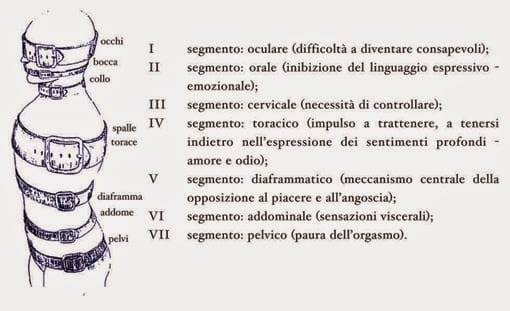
Reich identified seven “body segments” where the body accumulates chronic tensions that block the flow of vital energy.
Each segment corresponds to a body area and an emotional and communicative function. When one of these segments is contracted, energy doesn’t flow, and expressiveness – including vocal – drastically decreases.
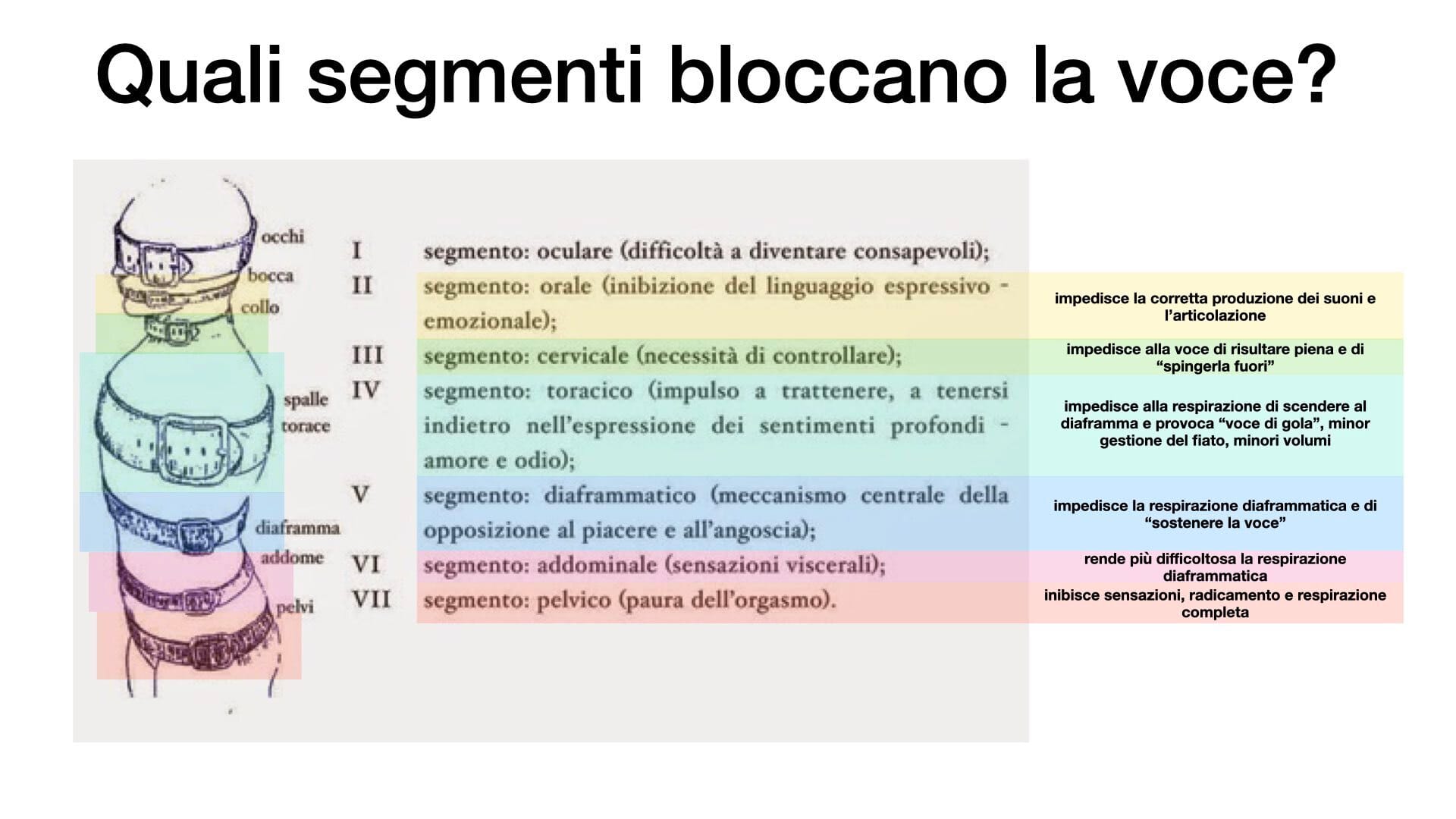
1. Ocular segment: dull gaze and loss of presence
The ocular segment concerns the eye and forehead area.
When it’s blocked, the gaze appears dull, lifeless, lacking light and depth : The eyes no longer communicate.
Tension in this segment can cause headaches, visual fatigue, and a sensation of “absence” in the gaze.
From a communication perspective, the gaze is essential, as everyone knows... "the eyes are the mirror of the soul": if the eyes lack expressiveness, communication loses its vitality.
A smile with the mouth but no smile in the eyes appears fake: there is a lack of expressive harmony between face and voice, a key element in every Voice Branding journey.
2. Oral segment: the mouth that doesn’t speak and the voice that holds back
The oral segment involves the mouth, tongue, and jaw.
It is where emotional language inhibitionoccurs: we learn to speak less out of fear, upbringing, or shame.
The result? A restrained, monotonous, poorly articulated voice.
Those with this block speak “with their mouth closed,” articulate little, and struggle to express genuine emotions.
Unlocking this area means reactivating the ability to "make yourself heard," regaining the freedom to say what you feel and doing so with a full, vibrant sound rich in human warmth.
3. Cervical segment: the throat that controls
The cervical segment is that of the throat, where the voice takes shape.
Here accumulates the need for control: we monitor what we say, stifle emotions, suppress crying, anger, or enthusiasm.
It is one of the most common blocks. The throat tightens, the voice becomes thin, strangled, “throaty.”
Until we learn to let it flow, we cannot express ourselves charismatically.
👉 In Voice Brand Training this is often one of the first areas to work on: through relaxation exercises, breathing techniques, and various other vocal exercises, the natural voice is reactivated and the block on vocal expressiveness is released.
4. Chest segment: holding back emotions and breath
The chest segment is the area of the heart, breath, and love.
When the chest is tight, we hold inside crying, anger, and affection, as if we were afraid to “feel too much”.
Breathing becomes short, high, and shallow.
You only breathe with the upper part of your chest, which also limits the voice.
(we know that for good vocal use it’s best to use diaphragmatic breathing, as you can also read in the article "How to Enhance Your Voice in 7 Steps")
A tight chest prevents full breathing and deep vocal vibration.
Releasing it means reopening both heart and voice, allowing communication to reach the emotional chords of those listening.
5. Diaphragm segment: the division between mind and body

When it is blocked, a split occurs: we are either too rational or too emotional.
The diaphragm is the “engine of the voice”: if it doesn't move, we can't support sound, nor access emotional depth.
Unlocking it means reconnecting with the body and finding a new balance between head and gut — between thought and vibration.
6. Abdominal segment: the center of emotions
The abdomen is the seat of visceral emotions.
When it's contracted, it blocks diaphragmatic breathing and limits air expansion.
A belly that is too tense or “flat” often indicates repressed emotions.
As I often tell my students: “flat belly, flat emotions”.
On the other hand, when the belly relaxes, breathing becomes deeper and diaphragmatic, you can connect with your emotional world, and your voice fills with vitality.
That’s why I jokingly say "a Winnie the Pooh belly and you get emotional too!"
7. Pelvic segment: the root of pleasure and grounding
The pelvic segment is connected to grounding, vital energy, and sexuality.
A blocked pelvis prevents "being present in reality," feeling centered and connected to your body.
It’s also where we hold our vital charge—the force that energizes voice and communication.
When this area is stiff, we’re “head in the clouds”: lacking power and stability.
Unlocking the pelvis means reconnecting with the earth, with strength and charismatic presence, enhancing grounding.
But that’s not all, pelvis and voice are closely linked: parts of the pelvis and sexual organs, and the mouth (especially the larynx and vocal cords) are deeply connected in terms of shape, physiology, function, emotional reactivity, innervation, etc., so working on pelvic movements also helps to free the voice and, conversely, working on the voice helps to improve sexuality.
👉 If you want to dive deeper you can read this mamaste article 🔗
From blocked energy to free
voice:
a vocal rebirth process
All these segments – from the eyes to the pelvis – are interconnected.
The voice is the final expression of an energetic process that flows through the whole body: if one point is tense, the flow stops and the voice loses life, harmonics, and truth.
The Voice Branding works precisely on this: combining knowledge of vocal physiology, bioenergetics, and charismatic communication, it helps people to release blocked voices and rediscover their expressive identity.
It’s not just a technical training, but a true journey of transformation:
from held-back voice to free voice, from control to authenticity, from speaking to communicating.
When the voice comes alive, everything changes
When the body is freed, the voice comes alive.
The gaze brightens, the face opens up, the breath deepens.
Words resonate, and those who listen feel your truth.
Expressive freedom is not just a skill, but a form of personal power.
Those who can speak with presence, naturalness, and intensity gain trust, empathy, and leadership.
And this is the heart of Voice Branding: turning your voice into the signature of your charisma.
How to unlock your voice and regain expressive freedom
Freeing the voice is not only a matter of vocal technique, but of psycho-physical integration.
The body speaks even before the voice, and every physical tension is an unspoken word, an unexpressed emotion.
Through progressive work on the body, breathing, and emotional awareness, you can release the blocks that limit your vocal expressiveness and completely transform the way you communicate.
1. Listen to the body: awareness is the first step
You can't free what you don't perceive.
The first step is therefore learning to listen to the body:
notice where you hold tensions, where you feel tightness or stiffness.
Those who live constantly in their mind tend to “abandon” their body, losing contact with their sensations.
Yet, your true voice is born there: from a living, present, vibrant body.
You can start with simple moments of daily awareness:
- observe how you breathe when you speak or get emotional;
- feel if your throat tightens or your shoulders rise;
- notice if your jaw is tense, if your gaze is rigid or your pelvis locked.
Only by recognizing these signals can you begin to transform them.
🔗 Also read: "How to Increase Self-Knowledge through Your Voice"
2. Free your breath: the key to vocal flow
As we have seen, diaphragmatic breathing is the foundation of expressive freedom.
The diaphragm acts as a bridge between thought and the emotion, connecting mind and body.
When it is contracted, the voice loses support, communication weakens, and the message fails to get through.
Here is a simple basic exercise to start reactivating it:
- Lie down or sit in a comfortable position.
- Place one hand on your abdomen and slowly inhale through your nose.
- Feel your belly expand as the air comes in.
- Exhale through your mouth letting the air out effortlessly.
Repeat for a few minutes each day.
This simple exercise reactivates natural breathing and creates a new inner space from which the voice can flow freely.
3. Release your neck and jaw
Two of the main blocks to vocal expressiveness are found in the neck and mouth.
When we overcontrol, we clench our jaw and tighten our throat, preventing sound from coming out.
A helpful exercise:
- slightly open your mouth and let your jaw drop down;
- breathe with your mouth half-open, producing a relaxed “aaah” sound;
- feel the sound vibrating in your throat without forcing it.
This simple action releases neck tension and opens up vocal space.
In Voice Branding, these practices are integrated and developed into personalized routines to restore fluidity and authenticity to the voice.
4. Unlock the chest and heart
The chest is often stiffened by years of held-back emotions.
Those who fear “feeling too much” tend to curl forward, reducing breathing capacity and expressive power.
To free it, you can practice small daily movements:
- stretch your arms wide as you inhale, as if embracing the air;
- make an open sound, like a laugh or a deep sigh;
- let your body naturally follow the rhythm of your breath.
This simple gesture brings energy back to the center of the chest, the place of charisma and empathetic connection.
5. Ground yourself: the voice comes from the earth
True vocal power doesn’t start from the throat but from the feet.
Grounding is the foundation of charisma: a confident, authoritative voice arises from a stable body that feels connected to the ground.
You can experience it like this:
- stand barefoot, feel your weight sinking toward the earth;
- slightly bend your knees and feel your pelvis relax;
- breathe deeply and vocalize letting the sound “sink” downward.
When you reconnect with the ground, your voice also fills with strength and centeredness.
It is the meeting point between voice and identity: the essence of Voice Branding 🔗
From vocal block to
charismatic voice:
the power of Voice
Branding
All these exercises aim to reactivate the body as a vocal instrument, but true transformation happens when you unite body, mind, and identity.
This is what we do in Voice Branding journeys: a holistic method that combines psychology, vocal physiology, and charismatic communication to help you transform your voice into your personal signature.
Through the three phases of the method
3️⃣ Voice Brand Application
we guide each person to:
- recognize their physical, emotional, and vocal blocks;
- develop a voice consistent with their personality and brand;
- communicate with ease, confidence, and magnetism.
In just a few weeks, the voice becomes deeper, more vibrant, and authoritative.
Within a year, all your communication becomes authentic, captivating, and charismatic because it stems from a body finally free and a defined, trained, and prepared Voice Brand.
Your voice is your freedom
Remember : The voice is the most direct expression of your vital energy.
When it is blocked, your life is too.
When it becomes free again, everything realigns: relationships, work, presence, charisma.
Freeing your voice means freeing yourself.
And this is the core of my work: helping you reconnect with Your Truth through sound, body, and words, with full awareness.
If you feel your voice is muted, held back or lacks charisma, it’s not a flaw: it’s a signal.
An invitation to come back to yourself, to your body, to your energy.
An invitation to give Voice to Your Uniqueness.
An invitation to discover and train your Voice Branding.
🔥 Want to find out what traps your voice and release it for good?
Book now your application consultation for the Voice Branding journey.
I will guide you on a personalized path to dissolve vocal expressiveness blocks, rediscover your authenticity and boost your charisma.
Do you want to develop a more captivating, charismatic and natural voice?
Discover how to apply these seven steps to your communication, and much more, with the personalized Voice Branding program.
👉 Book now your application consultation for the Voice Branding journey.
I will guide you on a personalized path to dissolve vocal expressiveness blocks, rediscover your authenticity and boost your charisma.
Give voice to Yourself.
Give voice to your
Personal Brand.
Give voice to your Uniqueness.
Looking forward to our call!
Alberto Ranzato - Voice
Branding Founder
FAQ: Frequently Asked Questions
È l’insieme di tensioni fisiche, emotive ed energetiche (collo, mandibola, torace, diaframma, bacino) che impediscono alla voce di uscire piena, naturale e carismatica.
Segnali tipici: voce “di gola”, fiato corto, mandibola e spalle tese, sguardo poco espressivo, difficoltà a modulare volume/tono, emozioni trattenute quando parli.
Sì. Riattiva il flusso del respiro, sostiene il suono e collega mente-corpo-emozione. È la base per ridare profondità, durata e armoniche alla voce.
Gli esercizi migliorano la tecnica. Il Voice Branding - tramite il metodo della Comunicazione Carismatica - integra corpo, mente, emozioni e identità, trasformando la voce nella tua “firma” comunicativa (design-training-application).
Dipende dalle tensioni e dalla costanza.
Con un percorso guidato e personalizzato di Voice Branding e Comunicazione Carismatica i primi cambiamenti si percepiscono in poche settimane.
You might be interested in...